
The power of prototypes
If a picture is worth a thousand words, what's a prototype worth?

This prototype of a graduate student portal helped the funding committee envision a unified student experience.
Sketching remains the quickest and easiest way to flesh out ideas. But when you're ready to go with a concept, and need to create deep understanding with your audience and stakeholders, there’s nothing more intuitive than an interactive prototype. Prototypes have so many positives. They can bridge the gap between design and engineering, especially with shared design components to ensure frictionless handoffs, reduce technical debt, and build unified components.
They create understanding of complex workflows
Working out complex product workflows is rarely a linear process, and static wireframes don’t represent the actual user experience. By building the user journey into task-based prototypes, we can test designs, uncover hidden friction points, and refine the UI alongside Engineering. Prototypes transform abstract workflow diagrams into a living, testable models, and are a practical tool to save engineering time, get stakeholder alignment, and reduct product risk.
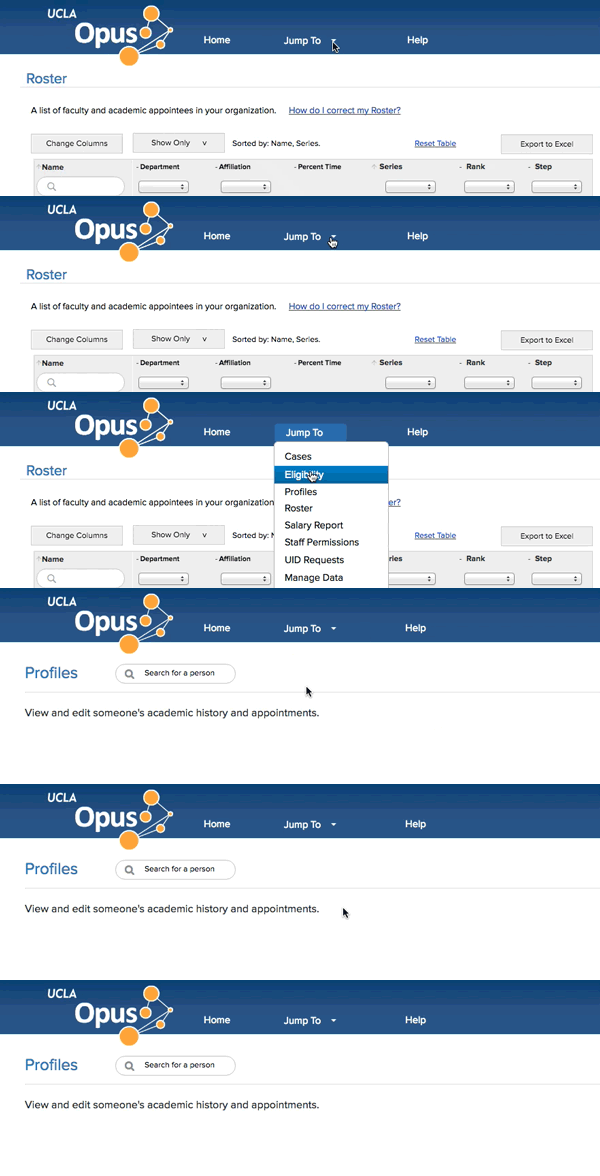
Interactive prototypes can align teams on information architecture. In this example, using the navigation within the prototype creates instant understanding of the site map.
The two truths problem
We used to have the "two truths" problem, where design files and production code used to diverge over time. However, AI tools now generate prototypes as real components, so design and engineering have the same source of truth. The prototype no longer diverges from the code.
Tokens, colors, spacing, typography, defined once and shared across Figma and code, mean an AI-generated prototype isn't just referencing the design system, it's built from it.
What’s the ROI?
When we invest the time into high-fidelity prototyping, the return on investment shows up across the entire product cycle.
Shorter Dev Cycles: Engineers have a crystal-clear model, improving team collaboration and understanding.
Stronger Stakeholder Buy-In: Leadership can "feel" the product experience, making approvals faster and more decisive.
Better User Testing: Users give feedback on the actual flow and friction points, rather than getting distracted by the aesthetics of static, unfinished wireframes.
Is there a time and a place for quick prototyping? Of course. But in high stakes situations, high-fidelity prototypes are more than just a preview of the final product. they are a powerful tool for alignment. By transforming abstract requirements into a tangible, interactive reality, prototypes show complex workflows, bridge the communication gap between design and engineering, and protect the organization from costly code rewrites.