

Buddhism and the Design Critique
Why designers have to be egoless, and how I learned to do it most of the time.
Why designers have to be egoless, and how I learned to do it most of the time.
Land of Bliss by Mary Watkins
Acrylic on canvas
A pictoral representation of a pure land sutra, done as a class project at Grinnell College.
What happens when you approach a critique session without attachment to outcome? A meditation on design, ego, and craft.
I have a super useful degree in Eastern Religion. What does that have to do with UX design? Good designers are detached. They don't care about being right, or being the best. They approach work with an open-minded curiosity and humility that results in the best possible product.
I’m surrounded by smart people, and one of the differences between my younger self and current self is that I don’t have to be the one to think of the good idea. Being humble in the face of user testing, or a stakeholder that immediately sees an issue you were blind to. “You’re right” is something I’ve learned to say a lot, and mean it. I no longer believe in the lone genius school of design. This kind of thinking used to get me in trouble because I would argue about what I thought was right. That’s not to say that as designers, we don’t have a responsibility to make sure our clients make good decisions. It’s just that I now realize that my job is not to have the solutions, but to facilitate a process that will lead to good design.
Once I was demoing a prototype of our new faculty information system to 300 medical center employees. They were not too thrilled about the idea of learning a new system - or systems in general. I told them at the beginning, “feel free to ask any questions at any time.” A guy raised his hand and asked ”Why do you use Roman Numerals in those job titles instead of plain numbers? It makes it so much more confusing!” The audience looked at me. I looked at the screen. And I realized... he was right! Gulp. What should I do? Should I argue? My first thought was they’ve always been that way, so I don’t think we’re allowed to change it. No, that wasn’t right. So I said “You’re right. Thank you!” He smiled. People started to raise their hands and offer all sorts of suggestions! It was beautiful! Suddenly they were present and involved.
The real trick to egoless design is to look at it from the user’s point of view. The user doesn’t care whose idea it is. We all share in the glory at the end if the product is successful. The process of the design critique is to make the product better! I am on a hunt to find improvements to the design. I relish finding these problems like treasures. This is the secret. Ironically. Rather than losing face, accepting critique gives me more credibility as a designer. People like working with me more. I am creating a safe environment for people to give me feedback. I am involving them in the design process. I value and implementing their feedback! Isn’t it ironic. Trying to make yourself look good never works.
Namaste.

UX Trends in Higher Education
AI, personalization, customization and more…
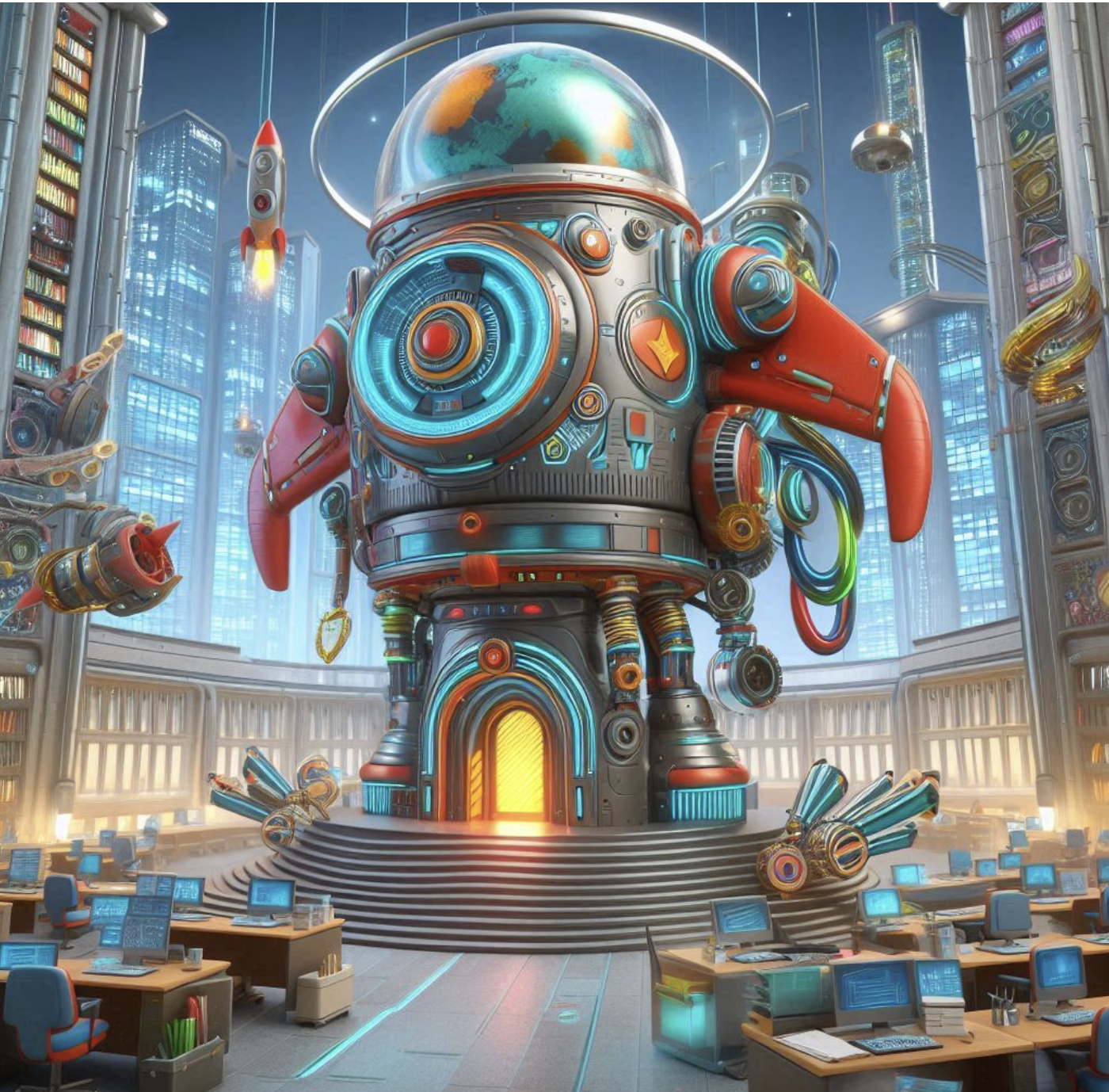
Image by Microsoft Co-pilot. Prompt: “funny futuristic sci fi university setting”
We’ve seen a huge growth in the number of people with UX titles in the University of California. There are a lot of people who are applying for these UX jobs. Our recent UX Designer position at UCSC had over 400 applicants. Why is this? One theory is that the recent tech layoffs have made the relative job security of higher education more attractive. And there are a lot of graduates right now, both in traditional UX degrees and from bootcamps.
But I think there’s an underlying motivational cause as well. Most UX designers are empathetic people and intrinsically motivated to help others. Recognizing that design is a powerful force, for good or for greed, they want to lend their efforts towards institutions that make the world a better place, like higher education or nonprofits.

However, there is a challenge once they get here. The fragmented and independent university ecosystem can frustrate UX designers. Getting used to the higher education culture is often a big change. At a corporation, design can be dictated from the top. But here, digital strategy and user experience is rarely dictated by the very top. Instead, everyone independently operates a myriad of systems and websites. Each department has unique needs. We add system after system that all operate independently and are unsustainable in the long run. The people who lose are the students, staff, and faculty who have to navigate through all these to get anything done. The tradition of intellectual freedom, independence and non-conformity has its pros, but also its cons.
UX Inclusion vs. UX Theater
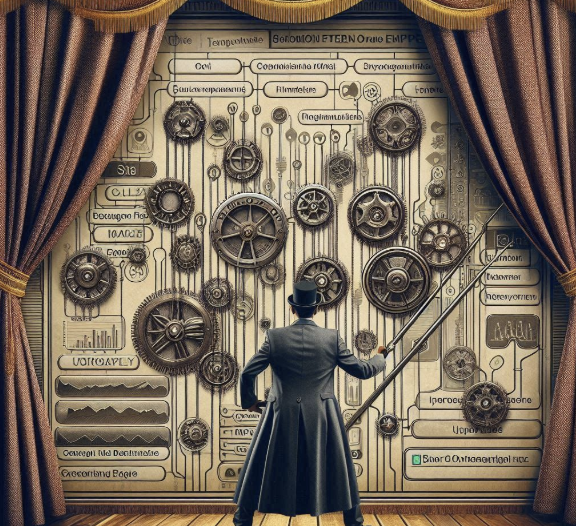
AI image by Microsoft Co-pilot. Prompt: “Create a man behind the curtain where the curtain is made of user interface symbols. Make it steampunk.”
The good news is that people are finally convinced that the user experience is an important part of technology. User experience is popping up in project plans everywhere. But unfortunately sometimes it just pops up as a buzzword without meaning or follow up. At the heart of UX is talking to real users. UX Theater is when you pretend to be user-centered without talking to actual users. One can claim that a new feature or product will improve the user experience, but sometimes this is based on an assumption without doing any discovery or research before defining the solutions.
Sometimes UX is used as a checkbox at the end of the project, as a final sign-off. By that time, of course, there’s nothing we can do but offer a few suggestions that are probably too late to implement. An ideal project plan has UX research baked into it, at the beginning discovery phase, as illustrated by the Double Diamond model, and tests with users throughout the project.
Universities are finally realizing this problem and are starting to understand the holistic student experience. We realize that we can no longer work independently on our own technological solutions, but consider the path through and between departments. This requires cooperation and a great deal of understanding and empathy. And it requires human centered design.
The Rise of Project Management
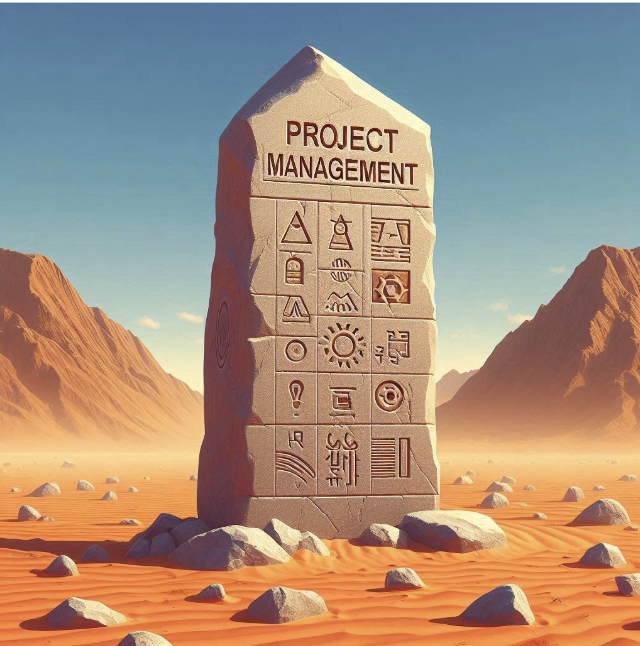
AI image by Microsoft Co-pilot. Prompt: “A monolith arises on the desert. Its hieroglyphs represent project management.”
No one wants IT projects to be over time and over budget. So it makes sense that Project Management is gaining more and more prominence in our IT organizations. Great project management is very helpful. But the solution is often identified immediately, and then steps backwards are identified to get to the end result.
As we in design know, the right problem to solve isn’t inherently obvious. Starting with the solution often means that you are solving the wrong problem. And the only way to know what problem you’re solving is to talk to users.
Sometimes a project management focus results in meetings time spent talking about the map instead of the territory. Instead of talking about what we have discovered and sharing information, the meeting is spent on checking off action items, consulting gantt charts, and finding out if the project is on track. While this is important, it cuts off creativity and problem solving, and discussion of insights that might lead us to a better solution.
One solution is to partner with the project manager to build in that discovery phase at the beginning, and build in user feedback. If we do that, the project will ultimately be more successful. And everyone wants that.
Death by 1000 Frameworks

How many frameworks is your team using? When you have too many, the framework monster can emerge.
AI image by Microsoft Co-pilot. Prompt: “create a monster coming out of a bunch of window frames and door frames.”
Frameworks are helpful. Frameworks can be useful. But we have so many of them. Agile, Scrum, Change Management, SMART goals, Six Sigma, ADKAR, Product Design, Service Design, and User Experience. These are often accompanied by strategic goals and principles. With so many frameworks and principles, how are we to get anything done? Which one is the dominant framework, that frameworks all the other frameworks?
People are burnt out on frameworks and principles. At work, rarely does anyone want to be educated, about UX, or anything that doesn’t involve what they’re trying to accomplish in that moment. There are thousands of things vying for our attention every day. People want to simplify and slow down the firehouse of information coming at them.
People are trying to do their job and get things done. And often the best value we can show as designers is to present the research and let it do the talking. Show the results, or the improvement in people’s lives that came from talking to users. Let your colleagues tell each other how involving UX helped their team. We can tell people why UX is important, but we can use the frameworks and techniques without forcing everyone else to learn them. UX is a profession, and it makes sense that you need some education and experience to do it well.
UX can be perceived as slowing things down

AI image by Microsoft Co-pilot. Prompt: "a sloth wearing cybernetic glasses in a futuristic room with computer chips"
Have you heard the following? "Let’s not have analysis paralysis." "What are the low hanging fruit?" "What are the action items?" With the complicated nature of user problems, it’s tempting to want to take action now. And sometimes there are obvious things we can do to improve things immediately. But sometimes we jump at a solution too quickly or solve the wrong problem. UX is heavily dependent on the discovery phase of a problem, and yet there is a natural inclination to want to solve things quickly. We know that in the long run that user research and consultation saves precious time and effort, but unfortunately this can be perceived as slowing things down.
How do we resolve this tension? A few ideas. One is to let the team take care of the low hanging fruit while the UX team works ahead. This lets the team work on some aspects of the problem that may be obvious, and people feel that they’re immediately working on things.
It may also help to do some risk analysis. What is the cost of getting this wrong, and how likely are we to get it wrong? This will help the team decide if it is more costly to do user research or not to do user research. So the next time someone says what are the low hanging fruit, maybe hit them with another metaphor, and ask them if they want to take some time to sharpen the saw before they cut those down.
Diversification and specialization of UX jobs

A delightful new ecosystem of design jobs is emerging.
AI image by Microsoft Co-pilot. Prompt: "diversification and specialization of species"
Many years ago, there was often one person, (problematically) called a webmaster, who was solely in charge of a website. Since then, web design has gotten infinitely more complex, and one person rarely has the skills or bandwidth to do all of it. Now we have front end developers, database engineers, back end developers, user interface designers, content managers, interaction designers, and many more.
As UX continues to grow, my prediction is that it will diversify in much the same way. The person who is a UX research expert with statistical analysis skills may not have visual design skills. A talented UX designer might not want to be a manager. In the future, I see Service Design, which focuses on not only the user experience but the backstage processes, growing immensely. With AI, a conversation designer may be an important role. Facilitation skills are also emerging as an important skill set, as a big part of our work is working with teams to map processes, identify pain points, and work through design problems.
We will need much more specialized skill sets, and a this new crop of job descriptions is already turning up. The UX team of one will maybe someday seem as antiquated as the webmaster position.
Specialization and prediction
For example, one way that we could help students is to no longer have them search for the right information, but to predict what they need, when they need it. Things like if they need to take a certain class to meet major requirements, if a research lab in their field of interest exists. Or even predicting actions based on the time of year or time of day.
Hyper personalization may be the next stage. This level of sophistication in higher education seems far away right now, but hopefully as our design in higher ed catches up to the outside world, we can take advantage of specialization and prediction.
AI. What is happening, and will it replace human designers?
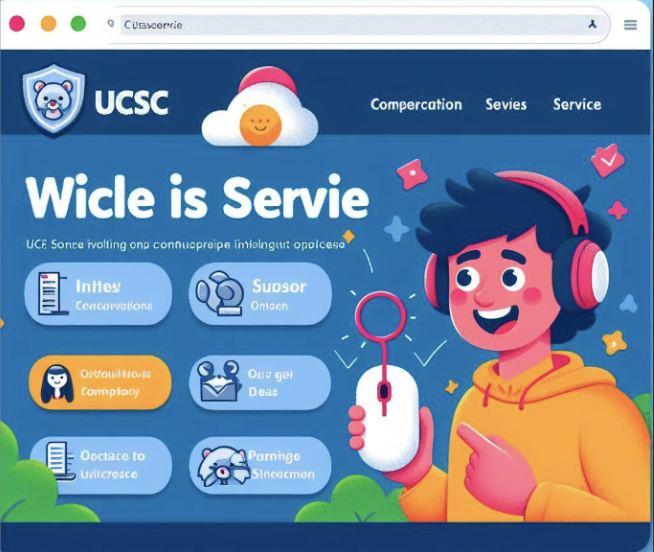
The AI didn’t do a great job at this point. Although we loved the heading “Wicle is Servie.”
AI image by Microsoft Co-pilot. Prompt: “Create a homepage for the UCSC IT Services website.”
What about AI? What is happening? Humans are terrible at predicting the future. For example, I didn’t understand social media and why strangers would want to see selfies of people they don’t know. I was also surprised by how fast AI developed, and how good it got in such a short period of time. A few months we were laughing about uncanny valley images that had people with six fingers. And now it’s so good we can’t really tell if something is AI.
But here’s the thing. Technical capability does not equal creative ability. Let’s use some analogies. People were worried when PhotoShop came out that it would replace the need for professional graphic designers. But all it did was allow more people to make really poor graphic design. Likewise, using your phone to take pictures does not make you Ansel Adams. Although the technical knowledge to create has been reduced, the artistic skill hasn’t.
AI is an accelerator, generating ideas. But we as designers are the curators of these ideas, picking out what is good and what is garbage.
Also, good AI also needs good data. And most of us are also not at the level where our data can be sufficiently leveraged to create chat bots and AI to help students.
Finally, talking directly to users is the heart of UX. Although AI is a useful tool, I can’t see it ever replacing actually talking to users. Design without talking to users is UX Theater, not UX Inclusion.
Breaking through unspoken rules and assumptions
Our outdated ways are going to change!
AI image by Microsoft Co-pilot. Prompt: “a television exploding.”
What’s the future of UX? We’ve only barely begun to understand the edges of what’s possible with computer human interaction. Even before designing, we already have constraints that we don’t even question. For example, the information must be presented within a rectangle. We must have a logo at the top of the rectangle. We must have a header at the top, and a footer at the bottom.
We may look at this in the future and laugh and wonder why we were so short sighted. After the adoption of technology, it seems so obvious what the previous constraints were. When we watch old science fiction movies we see immense computers that had dials and levers and wonder why we didn’t know people would have touch screens or a computer in their pocket.
Even creative people are trapped in the assumptions and constraints of their time. The same is true of us. We are trapped in the amber of the present era. Unable to even imagine the next level. The most restrictive constraints are the ones you don’t even realize are there.
Beyond Users: From Humans to Humanity

Let’s give some love to our planet.
AI image by Microsoft Co-pilot. Prompt: “the earth with love, claymation style.”
UX made a great leap by designing technology around humans, and not the other way around. It’s been described as the trojan horse that brought the humanities into technology. As hopefully our morality catches up to our technology, we may begin to consider beyond what’s good for humans and think about what’s good for humanity and the common good. Beyond that, perhaps we start to design for what’s good for the animals, the ecosystem, and the entire planet. Perhaps the design of the future will not be human-centered, but eco-centered. Humans don’t exist in a vacuum. We are all enmeshed in a living web, where everything affects everything else. The trash we create, the electricity we use, and all the other byproducts of technology come at a price for the planet. We can’t keep designing for our own convenience, but must eventually think of designing for the planet and its living ecosystem.
The user experience label has many variations and iterations: Human Computer Interaction, Customer Experience, Human Centered Design. As things change, and they always change, UX will be replaced by another name. The field will change, and the tools we use will change. But one thing will never change, and that’s the necessity for design. Many print designer jobs disappeared with the move to the internet. But a new crop of jobs designing electronic interfaces emerged. Those who were able to pivot still used their design skills, but changed the tools they were using.
Humans have had a compulsion to design and make their environment better since the beginning of time. Whether through clothing, housing, agriculture, books, art, or music, we are animals that design our environment. Technology will change, but it is not going away. When the screens disappear, something else will take its place, and it will need to be designed. Whatever comes next will have an interface, or a way that we interact with it, how it looks, smells, or sounds, or feels all require decision making and design. We will always design. And society will always need people with empathy to try to make people’s lives better, and the creativity to think of new ways to do it.
The power of prototypes
If a picture is worth a thousand words, what's a prototype worth?
If a picture is worth a thousand words, what's a prototype worth?

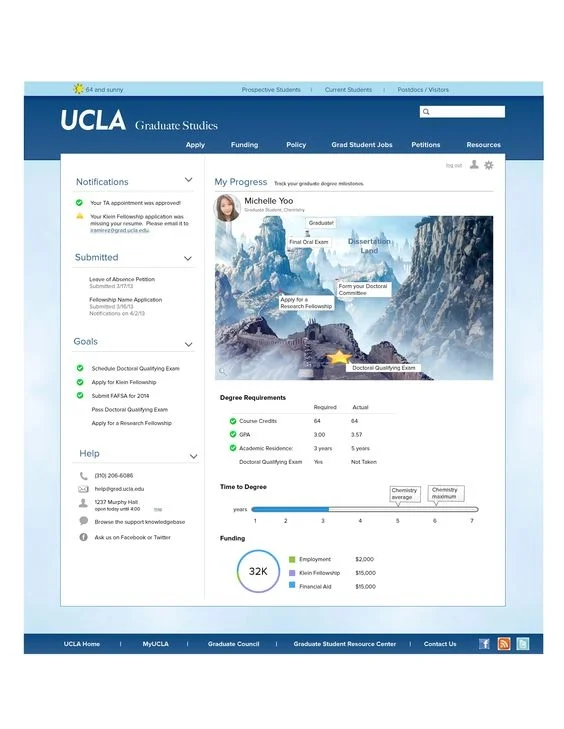
This prototype of a graduate student portal helped the funding committee envision a unified student experience.
Sketching remains the quickest and easiest way to flesh out ideas. But when you're ready to go with a concept, and need to create deep understanding with your audience and stakeholders, there’s nothing more intuitive than an interactive prototype. Prototypes have so many positives. They can bridge the gap between design and engineering, especially with shared design components to ensure frictionless handoffs, reduce technical debt, and build unified components.
They create understanding of complex workflows
Working out complex product workflows is rarely a linear process, and static wireframes don’t represent the actual user experience. By building the user journey into task-based prototypes, we can test designs, uncover hidden friction points, and refine the UI alongside Engineering. Prototypes transform abstract workflow diagrams into a living, testable models, and are a practical tool to save engineering time, get stakeholder alignment, and reduct product risk.
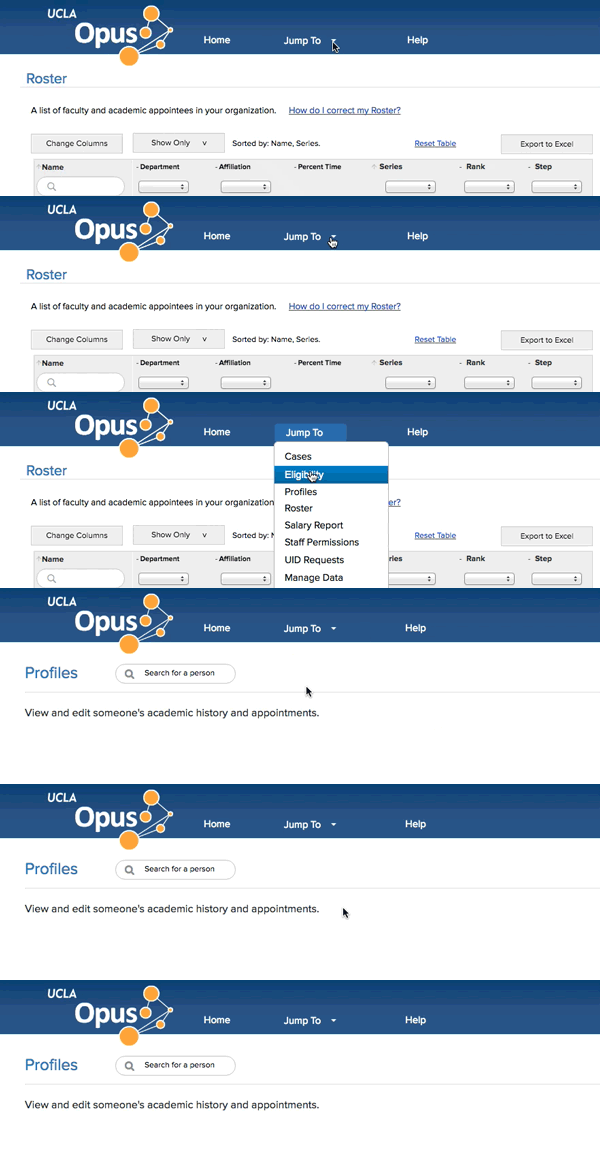
Interactive prototypes can align teams on information architecture. In this example, using the navigation within the prototype creates instant understanding of the site map.
The two truths problem
We used to have the "two truths" problem, where design files and production code used to diverge over time. However, AI tools now generate prototypes as real components, so design and engineering have the same source of truth. The prototype no longer diverges from the code.
Tokens, colors, spacing, typography, defined once and shared across Figma and code, mean an AI-generated prototype isn't just referencing the design system, it's built from it.
What’s the ROI?
When we invest the time into high-fidelity prototyping, the return on investment shows up across the entire product cycle.
Shorter Dev Cycles: Engineers have a crystal-clear model, improving team collaboration and understanding.
Stronger Stakeholder Buy-In: Leadership can "feel" the product experience, making approvals faster and more decisive.
Better User Testing: Users give feedback on the actual flow and friction points, rather than getting distracted by the aesthetics of static, unfinished wireframes.
Is there a time and a place for quick prototyping? Of course. But in high stakes situations, high-fidelity prototypes are more than just a preview of the final product. they are a powerful tool for alignment. By transforming abstract requirements into a tangible, interactive reality, prototypes show complex workflows, bridge the communication gap between design and engineering, and protect the organization from costly code rewrites.