
DX Land: The Game of Digital Transformation or Stagnation
When standard formats couldn't capture how unpredictable and human digital transformation really is, we designed a Chutes-and-Ladders-style game, and used AI-generated art to build a world around it.
Players: UC Santa Cruz and the California State University Chancellor's Office | My Role: Co-creator/ designer | Format: EDUCAUSE conference poster

High resolution file.
The Concept
The game of Digital Transformation (DX) is hard to win. After experiencing multiple digital transformation projects, we wanted to know what makes them succeed and what makes them fail. How much is chance vs. skill?
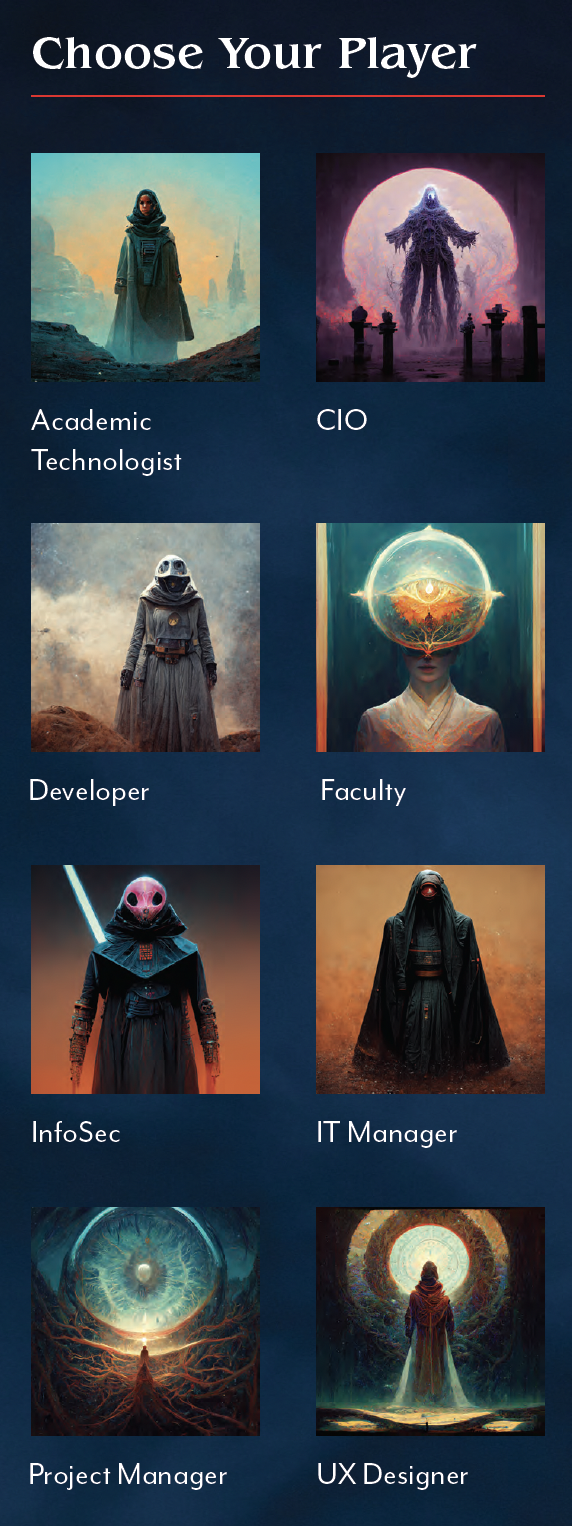
Choose your player…
The Players
This was a cross-institutional collaboration between UC Santa Cruz and the California State University Chancellor's Office, to pool our collective experience in transforming digital experiences into a conference poster. We all created the conceptual framework. I lead the visual design direction and AI art generation process, which was new territory for all of us at the time.
Translating experience into a game system
We started talking about the patterns we’d all seen in digital transofmation projects. What reliably accelerates a transformation? What reliably kills it? What's genuinely within a team's control, and what isn't?
What we found was often things were defined more by chance than we’d like. Luck matters. The same team, same strategy, and the same execution can produce wildly different outcomes depending on timing, politics, and circumstance.
So we transferred these experiences into a Chutes and Ladders-style game, one that intuitively communicates the non-linear, chance-influenced nature of digital transformation. Each game element was mapped to real patterns we'd observed: accelerators that fast-track progress, traps that can set teams back, and the role of institutional context that no amount of best practice can fully control. The dice roll embedded that truth into the game's structure without us having to say it.
Solving a real design constraint with an emerging tool
To execute our concept, we needed sci fi spooky artwork that would fit our “Stranger Things” theme. In the past, creating concept images could mean spending hours drawing or sourcing licensed assets. Neither fit our timeline or budget. Instead, we turned to DALL-E 2, then just months old, as our image generation tool. The result was imagery no stock library could have provided.
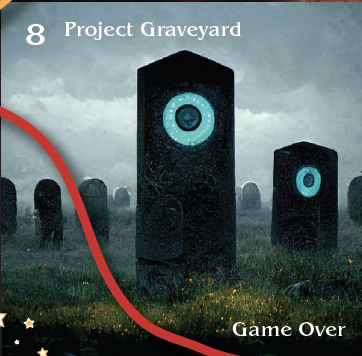
The “Game Over” square: a project graveyard with server tombstones.
What I also found was a tool that rewarded patience and iteration in ways I hadn't expected. The prompts that worked weren't always the obvious ones. Specificity helped, but so did unexpected combinations. "Project graveyard IT servers monitors tombstones" took many attempts before it produced something that balanced eerie atmosphere with enough visual clarity to read at poster scale.
Outcomes
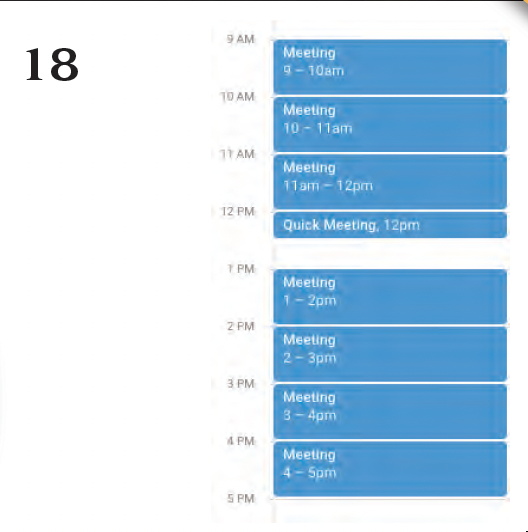
As in life, sometimes you land on a day filled entirely with meetings and lose your turn.
The poster generated genuine engagement at the conference. A format that could have been a dry matrix of best practices became a conversation piece. Participants engaged with the game format as a lens for reflecting on their own DX experiences, making the knowledge transfer more effective than a standard research presentation would have been.
It also gave me an early, grounded view of where AI tools in design actually add value and where they don't. The tool didn't make creative decisions for us. It expanded the space of what was possible given our constraints.
The Poster- high resolution file